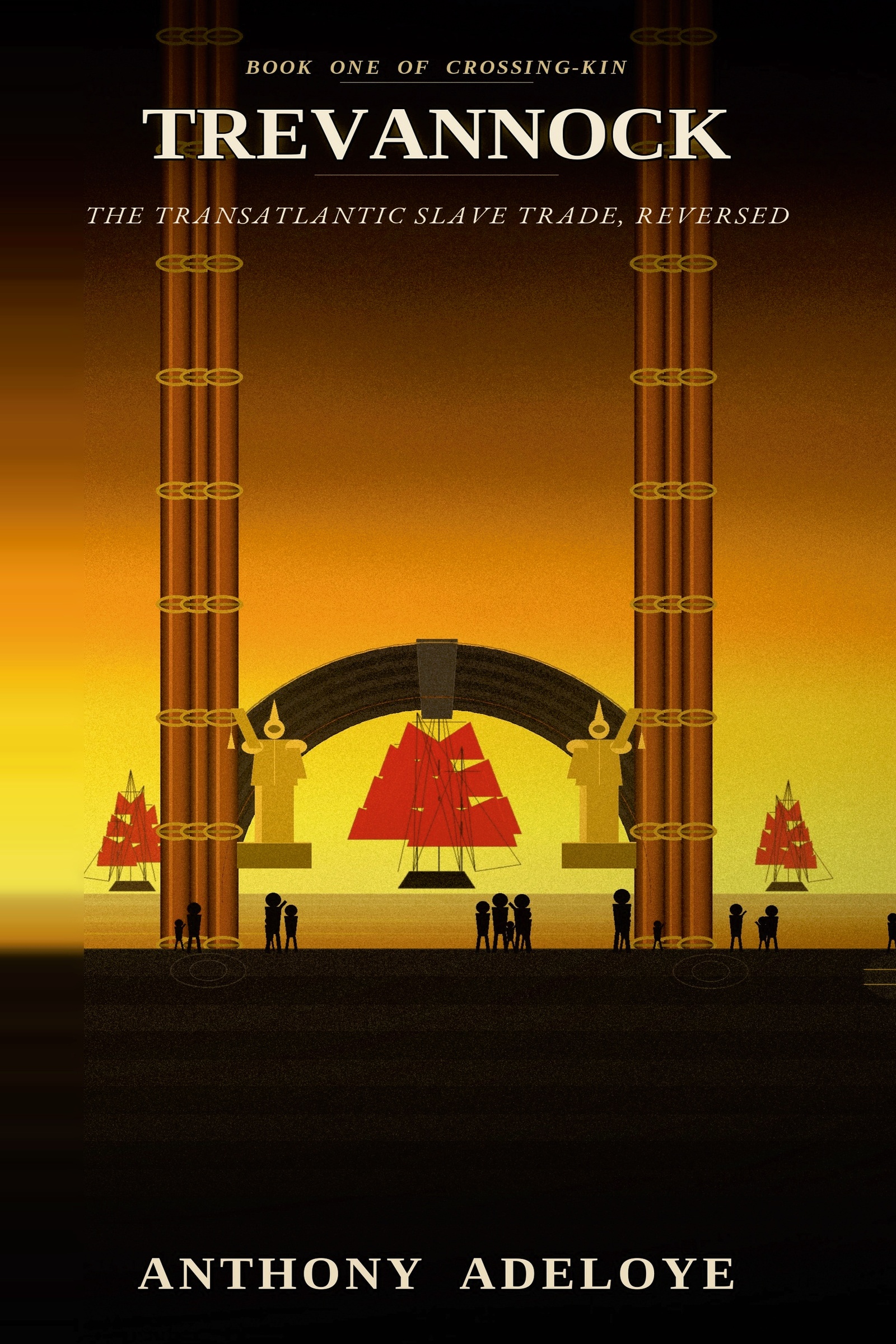
Book One · The Crossing-kin Series

TREVANNOCK

What if the transatlantic slave trade had sailed the other way?

1782. The African Adunbi Imperium runs the trade against Europe. An African commander. European captives. One voyage that rewrites everything.

Trevannock — Book One of the Crossing-kin series
The Crossing-kin Series · I
TREVANNOCK
Anthony Adeloye
The Story

History, reversed.

History remembers who was taken. Trevannock asks what if it had been the other way round.

In 1782 the African Adunbi Imperium runs the transatlantic slave trade against Europe. The ledgers are opened, the auctions begin, and Europeans are the ones renamed and sold across an empire that calls it order. Through the people caught inside that machinery — the owned and the owners — the familiar architecture of slavery is turned inside out until it becomes impossible to look away from.

This isn't a revenge fantasy. It's an attempt to make a familiar horror feel new — to understand it by standing somewhere we've never stood. Book One of the Crossing-kin series.

An African commander

Power, seen from the other side of the deck.

European captives

The taken, renamed and inventoried — a mirror held to history.

One voyage

A single Atlantic crossing that rewrites everything.

Start Reading

Read the novel free — chapter by chapter.

New chapters and scenes land first here, with the history and research behind the “what if.” Start at the beginning:

Chapter One
The Cove at Dawn
Where it begins.
Read now
Chapter Two
Coming soon
Subscribe to get it first.
In progress
Chapter Three
Coming soon
Subscribe to get it first.
In progress

Point “Chapter One” at your exact Substack post URL, and add chapters here as you publish.

Get the Book

Own the whole story.

Read free as it unfolds — or get the complete novel now, and support the work.

Paperback
£10.99
ISBN 978-1-0667065-0-1
Amazon UK
Kindle / eBook
£4.99
ISBN 978-1-0667065-1-8
Amazon Kindle
Hardcover
£19.99
ISBN 978-1-0667065-2-5
Order
Nigeria
₦11,000
Paperback · eBook ₦3,500
On Selar (soon)

Also on Goodreads — add it to your shelf and leave a review.

Add the Selar link + hardcover retailer when live. Nigerian prices set for the local market.

Behind the Book

The history behind the “what if.”

The research, the real history, and the choices behind the reversal — published alongside the novel:

Praise

What readers are saying.

“[Your best reader quote or review goes here.]” — Reviewer, Publication

Add real Goodreads/reader quotes here as they come in.

The Author

Anthony Adeloye

Anthony Adeloye

Anthony Adeloye is a Nigerian-British author. Trevannock is his debut novel and the opening book of the Crossing-kin series — alternate history that reverses the familiar direction of the past to look hard at power, ownership and memory.

He is also the founder of CalyTeQ, a quality-engineering consultancy — a career spent studying the quiet machinery of institutions, which found its way into the novel.

LinkedIn · X · Goodreads · anthony@adeloye.com

Join the crew

Get the next chapter first.

Subscribe free and I’ll send new chapters and scenes as they’re written, the history behind the “what if,” and first look at everything before it goes anywhere else.

Subscribe free

Tip: replace this button with your Substack embed — <iframe src="https://adeloye.com/embed"> — for inline sign-up.

Trevannock · Book One of the Crossing-kin series
Chapter One — The Cove at Dawn

Elias rose before light.

He had always risen before light, as his father had done, and as his father had done before him, and as every man of his line who had ever drawn a wage from the sea had done since some fisherman in some prior century had first understood that the herring will not wait. In Trevannock the rising before light was not so much a habit as a kind of devotion, undertaken without much thinking by men who would not, if asked, have called themselves devout. They had not, in truth, been permitted by the parish authority to use the word devout of anything that was not the official Adunbi religion for some forty years, and the men of the cove had, in those forty years, become careful with the words they used about themselves.

The cottage was cold. The fire in the kitchen hearth had been banked low against the night, and what little heat it had given out had been claimed long ago by the stone of the floor and the lime of the walls. The lime was cracked at the corners where the damp came up through the foundation. It had been cracked, by Elias's own count of his repairs, since the autumn of 1778, and he had not, in the three years since, found the time or the small reserve of money to do anything about it. He sat for a moment on the edge of the bed — the bed in which Annwen had died three winters since — and pulled on the breeches he had laid ready on the chair the night before. The chair was the chair her father had given them when they were married. The breeches were the third pair he had owned in his marriage. The first had been buried with her, by her own asking, because she had liked to see him in them. The third pair, like much of what was in the cottage now, was older than the second had been at the time of the second's burial, and would not, by his careful estimate, last another winter.

He dressed by the small grey window. It was a habit he had kept since her death, this dressing by what light the moon or the dawn or the stars would give him, because to light the rush-candle and risk waking the children meant ten minutes of Tom's questions and Mae's small soft hand on his sleeve and the slow business of getting them back to sleep, and the herring did not wait for any of that either. The rush-candle, in any case, was the last of the parish's monthly ration of three. He would not waste it on a morning he could dress in the grey.

In the kitchen he laid out three things, as he laid out three things on every morning of his working life.

The first was the bread that Mae had cut him the night before, three slices wrapped in a square of waxed linen and tied with a length of red thread. Mae was eight years old in May. She had been doing the bread for him since her mother had died — at first with help, then with less help, and now, in the third winter, without help at all. The bread was coarser than it had been when Annwen was making it. The flour the parish miller had been receiving from the colonial granary at Penzance since the corn ration was reduced in the spring of 1780 was milled with a higher proportion of barley and a higher proportion of stone-dust than the parish remembered the bread of their childhoods being made of. The bread was almost always too thick at one end and too thin at the other, and Elias did not, in any morning of the three winters, point this out to her.

The second was the small earthen flask of cider that he had filled at the barrel by the door, watered down to the kind of strength that would not, in the small enclosed space of an open boat, knock him over before the morning was out. The cider was the last of the autumn's ration. The Penzance customs office had, in the late autumn of 1781, reduced the parish apple allowance by a further fifth on the basis that the parish had not, in the year preceding, met its tithe in dried fish. There would be no fresh cider in the cottage until October. He had given up the strong cider when Annwen was buried in any case. There had been a brief year in which he had not given it up. The brief year had been the worst year of his life, and he did not, now, return to it.

The third was the small wooden carving he carried in his pocket — a fish, the size of his thumb, made by Tom, who was six, and given to him in the autumn of 1781 as a name-day present. The fish was very rough, with a long body and a short tail, and bore — as Tom had been careful to assure him — no real resemblance to any fish his father had ever caught, but rather to a fish Tom was sure existed in the deeper water and had given himself the work of imagining. The wood had been a small offcut from a broken thwart of the boat. Elias had kept the offcut in the back of the kitchen press for some months, because the Adunbi customs office at Penzance had, since the spring of 1779, required a permit for any piece of worked timber over the length of a forearm, and the parish men of the cove had begun, by quiet practice, to keep their offcuts hidden against the inspection that came every Lammas. Tom had not known any of this when his father had given him the offcut on the morning of his sixth name-day. Tom had only known that his father had given him a piece of good elm and the smaller knife and the run of the kitchen for the afternoon. Elias had said, on receiving the carved fish back at the end of the day, that it was the finest fish he had ever seen, and that he would carry it with him on every boat he ever put to sea in. He had carried it on every boat he had put to sea in since.

He let himself out of the cottage by the back door.

The front door faced the road, and the road faced the lights of the village, which at this hour were all out, and the closing of the front door at this hour would, in the small still air, be heard by neighbours who would feel obliged to comment on it the next time they saw him at the well. He closed the back door softly. The wooden latch gave a small click. The chickens in the run did not stir. The run had been built in 1771 by his father from timber that had then required no permit. The current run, if Elias were to rebuild it, would require an Adunbi customs permit costing four shillings, which Elias did not, on this morning, possess.

He stood for a moment in the yard. He could not, by long habit, walk away from the house in which his children were sleeping without standing for a moment in the yard.

The morning was clear. The wind was from the south-west, a light wind, the kind of wind that would do well for the first hours of a working day and would, by mid-morning, have lifted enough to bring them home before the heat of the day was high. The sky to the east was the colour his mother had called shilling-grey — neither dark nor light, neither night nor morning, the grey of a coin in your hand on which you have not yet decided whether to spend it or to keep it for later. His mother had used the phrase when the only shillings the parish saw were English shillings, before the Adunbi customs office had begun, in 1772, requiring a portion of all parish trade to be settled in manillas. Elias's own pockets at this hour contained one English shilling, three pence, and two manillas — the small brass crescents of Adunbi colonial currency that were now accepted at every stall from Falmouth to Land's End. He had stopped, some years ago, telling Mae the story of why the sky was called shilling-grey, because the explanation took longer than the colour deserved.

Above him, the gulls had not yet begun to call. The gulls would begin in the next quarter-hour. The gulls knew, as he knew, that he was on his way to the cove.

He walked the path down to the harbour.

The path passed, at its first turn, the small stone cross that had been the parish boundary marker since the early years of King James. The cross had been the marker of the parish church for one hundred and forty years before that. In the spring of 1769, by an instruction from the office of the Lord Lieutenant relayed through the colonial overseer at Penzance, the small Adunbi sigil of the Akande administrative district had been chiselled into the lower portion of the cross. The chiselling had been done by an English mason from Falmouth who had taken the work because his own children needed feeding and who had, on completing it, walked into the chapel and prayed for forgiveness. The Adunbi sigil had weathered in the thirteen years since. The English cross above it had weathered for four hundred. The two weatherings were now of nearly equal depth, and a stranger to the cove would not, in this hour, easily say which had been there first.

Elias passed the cross without looking at it. He had been passing it without looking at it for most of his thirty-five years.

The harbour at Trevannock was not, by the measure of harbours, large. It held thirteen boats. Six of these belonged to families who had been in the cove since the parish records began, which was the early years of King James, and seven belonged to families who had come in within the last fifty years — some by marriage into the old families, some by purchase of vacant berths, two by quiet arrangement after the loss of an heir at sea. Elias's boat — the Annwen, named for his wife in the second year of their marriage, three years before she died — was tied at the western end of the stone quay, in a berth his father had bought from a man called Lugg in 1739 for the sum of four shillings and a winter's worth of salted pollack.

The Annwen was a thirty-foot lugger. She had been built in Mevagissey in 1768 by a yard that no longer existed, and she had been bought by Elias's father in 1771 from the family of the man who had ordered her and then died in his bed before her launch. She had cost Elias's father every penny the family had set by from a generation of fishing, and she had paid them back, by the slow careful work of two generations, in the eleven years since, and she would, with the slow careful work of her present master, pay back another. The Adunbi customs office at the harbour mouth — a low stone building put up in 1763, with a slate roof in better condition than any roof on a parish house — held the boat's annual registration on a small parchment slip behind glass. The slip had been renewed every Lammas since the boat had been bought. The renewal cost two shillings and one manilla and required the submission of a small portion of the previous year's catch as a registration tithe. The tithe in 1781 had been four stone of salted pollack. The tithe was expected to increase in 1782.

Above the doorway of the customs office, in the small lamp-bracket that had been mounted there in 1764, the customs lamp burned all night. The lamp was tended by the customs officer's assistant, a man named Penhaligon from a village three miles east, who had been the assistant for fourteen years and who would, by his own occasional admission at the inn, have given up the work if there had been any other work in the district that paid the same and required no permit to undertake.

Penhaligon was at the lamp when Elias came down the slip. He was extinguishing it for the morning.

"Hollowell."

"Penhaligon."

"Catch tithe at the end of the morning. Customs officer's instruction yesterday evening. Half a stone if you bring in good."

"Half a stone."

"He has been told from Penzance."

"Aye."

"He does not, between us, like it either."

"I know, Penhaligon."

Penhaligon nodded once and went into the customs office. The door closed. The light inside the office came on a moment later — a different lamp, smaller, the morning lamp, the one that would burn until the office shut at sundown.

Elias walked the rest of the way down the slip to the boat.

Old Tom Bligh was already at the boat.

Old Tom was sixty-one, and he had been Elias's partner since the spring of 1776, six years now, since the death of Elias's father had left Elias too young by some years for the work and Old Tom too old by some years for the work alone. Old Tom lived with his daughter, who had married a man from a village four miles up the coast, and who would not, the daughter, have been able to keep her father in her own kitchen if Old Tom had not had the daily work of going down to the harbour with the Hollowell boy. The arrangement had been, as such arrangements often are, the kind of accident that everyone had needed. Old Tom had been at sea, by his own count, since 1734. He had been at sea before the Adunbi customs office at the harbour had been built, before the parish church had been required to mount the Adunbi sigil above the lintel, before the English shilling had been required to share a pocket with the manilla, before any of the small accumulated impositions that the parish had, in the intervening half-century, accepted as the price of continuing to exist where it existed. He had seen the impositions arrive one at a time. He had not, in his sixty-one years, seen any of them ever leave.

He raised one hand in greeting as Elias came down the slip.

"Wind from the south-west," Old Tom said.

"Aye," Elias said.

"Will hold to mid-morning."

"Aye."

"Will not hold past."

"No."

They worked in silence for some minutes. The nets had been mended last evening by Mae — Mae was old enough now to mend nets, and she did them in the kitchen by the fire with her father after the supper was cleared, and she was, by Old Tom's quiet measure to which he had not yet given voice, a better hand at the mending than her mother had been. They loaded the nets into the boat. Old Tom checked the sail. Elias checked the rudder. The light to the east shifted up by a degree.

"Penhaligon said half a stone," Elias said.

"Aye."

"He said it was from Penzance."

"It always is, lad."

"It was four pounds last Lammas."

"Aye."

"They will, by next Lammas, have it at a stone."

"They will," Old Tom said, without looking up from the rudder pin he was wedging into place. "And by the Lammas after that, the parish will not be able to pay it, and the boats will be re-registered to the customs office in trust, and we will be paying for the use of a boat that was ours by the same hand that took it. I have seen this done in three villages along the south coast in the past nine years."

"Old Tom."

"Aye, lad."

"I have not, in three years, heard you speak this directly of it."

"I am sixty-one," Old Tom said. "I have one or two years of speaking left. I am beginning, slowly, to spend them."

Elias did not, for some seconds, answer. He looked at Old Tom, who was at the gunwale with his back to the harbour mouth, his weathered face in the grey light not turned toward Elias but toward the boat. There was a thing in the set of Old Tom's shoulders that morning that Elias had not seen before. He could not, at that hour, have named the thing.

They put off from the quay.

The water of the cove was, at that hour, a flat dull grey. There was no chop. The boat rode out into the bay under the light pull of the sail, and Elias and Old Tom took their accustomed places — Elias at the tiller, Old Tom at the forward thwart — and they watched the village of Trevannock slip behind them as the sky slowly began the work of becoming morning.

At a distance of perhaps a quarter-mile from the harbour mouth, Elias took the boat north along the coast. The herring would not, this morning, be in their summer ground. The herring had been working southwards in the past week, following the warmer water; Old Tom had said so the previous evening, and Elias had not had reason to disbelieve him. They would go up the coast to where the small headland at Carrick stood out into the bay, and they would, just past the headland, find the water in which the herring were now feeding.

As they passed the headland, Old Tom raised his head.

"Three sails," Old Tom said.

Elias looked.

Far out — perhaps three leagues from the coast, perhaps a little more — there were three white sails. Adunbi sails. Not the small coastal sails of the inspection cutters that worked between Falmouth and Penzance and were a daily sight on this water. Not the merchant sails of the trade vessels that came up the coast twice a season carrying the manufactured cane sugar of the colonies and taking back the tin and the wool. These were the larger sails of the three-masted procurement class, square-rigged, the sails of a kind of ship that Elias had seen at sea perhaps a dozen times in his life and had, on each of those occasions, seen at a greater distance than this.

They stood at the gunwale for some seconds. The sails were too distant to make out details. The three ships were under reduced sail, perhaps half-furled. They were not, by their attitude, going anywhere quickly. They were holding station off the coast.

"Old Tom," Elias said.

"Aye, lad."

"The pennants."

Old Tom did not, for several seconds, answer. He had been looking at the three ships from the moment they had come round the headland. He had been looking, Elias understood now, not at the ships but at the pennants above the topmasts. The pennants from this distance were small and pale. A man of Old Tom's age and eyesight would, in the ordinary run of things, have been hard put to read them. Old Tom had, by some discipline of attention developed across decades of having to know what kind of Adunbi vessel was off his coast at any given moment, learned to read them.

"Procurement," Old Tom said.

Elias looked again. He had seen the procurement pennant perhaps twice in his life, both times in the harbour at Falmouth where the ships had been provisioning between voyages further south. The pennant was a thin black bar above a white field, with the small Adunbi sigil of the procurement service in the upper corner. From a quarter-league out it was readable. From three leagues out, only a man who had been waiting some time for the worst news the coast could deliver would have made it out.

"All three," Old Tom said.

"All three."

"They have been moving up the coast since the spring. I had it from my nephew at Falmouth on Sunday. He did not, at that time, say where. He said only that the procurement fleet had moved."

"You have not, in three years, told me your nephew brings you news from Falmouth."

"I have not, in three years, lad, had cause."

Long beat. The boat rode the small chop of the changing wind. The three sails held station. They were facing south. They would, by the slow patience of a fleet that had been doing this work for one hundred and sixty years, choose a parish by the small criteria the procurement service had refined across that century and a half, and they would, when they had chosen, send the longboats in at first light of the day they had chosen, and the parish they had chosen would, by the evening of that day, be the next parish on the coast whose name was no longer added to the lists of corresponding parishes.

"Old Tom."

"Aye, lad."

"How many parishes have they done this year."

"Twelve."

"Twelve."

"That I know of, lad. By the count of letters not arrived where letters used to come."

"In what counties."

"Three in Brittany over the winter. Two on the Welsh coast in April. Four on this coast in the past six weeks. The remaining three are on the Atlantic coast of France above Brest. The fleet works the channels in a slow rotation. It has not, in the present year, come this far west of Falmouth before."

"It is here now."

"It is here now."

They stood at the gunwale for some time. Neither of them, in that time, spoke. The three sails did not move. The sky to the east lifted a further degree. The first gulls began to call above the headland.

"Old Tom."

"Aye."

"We are going home."

"Aye, lad. We are."

Elias put the tiller over.

They came back into the harbour at perhaps a quarter past seven. Penhaligon was at the customs office door. He looked at the empty hold of the Annwen as the boat came alongside the quay. He did not, by his face, ask the question.

"We turned back at the headland," Elias said. "Wind shifted."

"I will mark it in the book," Penhaligon said.

Penhaligon went back into the office. Old Tom and Elias secured the boat. They did not speak. There was nothing, in this moment, that needed to be said between them. Elias would go home. Old Tom would go home. They would each, in their own kitchens, think about the three sails for perhaps another hour. They would then, by the small disciplines of men who had grown up inside an occupation, decide what they were going to tell their respective households, and they would, by some hour of the morning, tell them.

Elias walked the path back up to the cottage. The cross with the Adunbi sigil chiselled into its lower portion was at the first turn of the path. He did not, on this morning, pass it without looking at it. He stopped. He stood for some seconds in front of it. He had walked past the cross perhaps fifteen thousand times in his life. He had not, in any of those passes, looked at the sigil long enough to read it.

He read it now.

The sigil was the small angled triangle of the Akande administrative district, with the three vertical lines of the procurement service in the lower right. The procurement-service mark on a district sigil meant, by the formal designation of the colonial code, that the district had been judged by the procurement office as eligible. The mark had been on the cross since 1772. The eligibility had been formal for ten years. The procurement fleet had not, in those ten years, come for the district. It had been, by some calculation of the procurement service that no man in the parish knew the reasoning of, eligible but not selected.

Until now.

Elias stood at the cross for perhaps a minute. Then he walked on.

At home he found Mae and Tom in the kitchen.

Tom was on the bench by the fire with a small piece of wood and Elias's smaller knife, working on something he would not, at this stage of its making, allow his father to look at. Mae was at the table sorting the morning's milk into the two pans for the cream.

"How was it, da," Mae said.

"We turned back, lass. The wind shifted at the headland."

"No catch, then."

"No catch."

She nodded. She was eight years old. She had, since her mother had died, learned the small economies of a fishing household and learned them, by her own slow attention, well enough to know what a morning with no catch would mean for the week's larder. She did not, by her face, complain. She returned to the milk.

"There were three sails," Tom said, from the bench by the fire.

Elias turned slowly. He had been hanging his oilskin on the peg by the door.

"How do you know about three sails, lad."

"Master Tregaskis was at the well when Mae fetched the water. He told Mistress Bligh. Mae told me when she came back."

"Mae."

"Aye, da."

"What did Master Tregaskis say to Mistress Bligh."

Mae did not look up from the milk. She was, by the careful hold of her shoulders, choosing the form of her answer.

"He said the customs officer at Penzance has, since yesterday afternoon, been telling the parish men of the inland villages that they are to keep their boats in harbour for the present. He said the three sails are off Carrick and Mount's Bay. He said the Lord Lieutenant has been informed."

"He said this to Mistress Bligh at the well."

"Aye, da. He said it slow enough that I heard him without him knowing I heard."

Long beat. Elias looked at his daughter, who was eight years old, who was sorting milk into pans with the careful attention of a woman who had been doing it for forty years, and who had — by some apprenticeship of her three widowed winters that he had not, until this morning, fully understood — become the kind of child who heard what the parish men were telling each other at the well and who decided, by herself, what of it her father needed to know.

"Mae."

"Aye, da."

"Did you understand what Master Tregaskis was saying."

Mae set down the wooden spoon. She did not look at her father.

"I understood, da, that the three sails are the kind that mean the parishes to the west have been right to be frightened. I understood that Master Tregaskis was telling Mistress Bligh because Mistress Bligh's husband is one of the men Sir John will send for if the Lord Lieutenant orders the muster. I understood that you would, when you came home, have seen the three sails for yourself and would, this evening, be one of the men Sir John sends for too."

Elias did not, for some seconds, speak.

"You understood all that."

"I am eight, da."

"Aye, lass."

"I have been listening for some weeks."

"Aye, lass."

She turned back to the milk. She picked up the wooden spoon. She did not say anything further about the three sails. Tom, on the bench by the fire, had not heard what he had heard. He was six. He had, by his sister's careful management of the household across the past three winters, been protected from the things a six-year-old did not need to know yet.

Elias stood for some seconds at the door with his oilskin still in his hand.

"Lass."

"Aye, da."

"What did Master Tregaskis say about the children."

Long beat. Mae did not, for several seconds, look up from the pan.

"He did not say about the children, da."

"What did Mistress Bligh ask him about the children."

"She asked him whether the procurement service took the children, da, or whether the children were left."

"What did he say."

"He said the procurement service takes the children who are above the age of seven. The smaller ones are left."

Beat.

"Where are the smaller ones left, lass."

"He said the smaller ones are left in the houses, da. With the doors shut."

Elias hung the oilskin on the peg.

Tom was eight years old in October. Tom was, on this morning of May, six. Mae was eight years old.

Mae was eight years old.

He went, an hour later, to Mr Penrose at the schoolhouse on the pretext of bringing Mae and Tom to the morning lesson.

The morning lesson had begun at nine. It was now half past nine. Mae and Tom were ordinarily at the schoolhouse by nine and home by eleven, but Elias had, on this morning, kept them at the cottage until he had washed at the basin and changed his shirt and recovered enough of himself to walk into the parish without his face showing what his face had shown when he had stood at the harbour an hour earlier looking at the three sails.

He walked them down. Mae carried her slate. Tom carried his small wooden whistle, the copper one Elias had bought him at the Penzance fair in May. They walked the half-mile to the schoolhouse along the same path Elias had walked at first light. They passed, at the first turn, the cross with the Adunbi sigil chiselled into its lower portion. Tom asked, as he had asked many times before, what the chiselling meant. Mae told him, as she had told him many times before, that it was the mark of the district. Tom asked whether the mark was English or Adunbi. Mae said Adunbi. Tom said: And the cross. Mae said: The cross is English. Tom said: Why are they together. Mae did not, on this morning, answer. She looked at her father.

Elias said: "Because the district is in two places at once, lad."

Tom thought about this. He did not, for some moments, speak.

"Da," Tom said.

"Aye, lad."

"Are we in two places at once."

"Aye, lad. We are."

"How."

"We are English by our names. We are Adunbi by the parish."

Tom thought about this. They walked the next quarter-mile in silence. As they came up to the schoolhouse, Tom said: "Da. I would rather be in one place."

Elias did not, for some seconds, answer.

"Aye, lad," he said at length. "So would I."

They came to the schoolhouse door.

Mr Penrose was at the door of the schoolhouse when they arrived.

Mr Penrose was sixty-four years old. He had been the parish schoolmaster since 1751, which was thirty-one years, and he had been the keeper of the parish register since the death of his predecessor in 1758. He had been Annwen's father. He had been the man who gave Annwen, by his own slow careful teaching, the literacy in both English and Adunbi that had made her, in her short life, one of the few women of the parish who could read both the parish prayers and the colonial notices that came down from Penzance. He was, on this morning, in his black coat with the small worn velvet at the collar. He had seen Elias from a distance of perhaps fifty paces. He had been waiting at the door from the moment he had seen him.

"Hollowell," Mr Penrose said.

"Mr Penrose."

"Mae. Tom. Inside. The other children are at the alphabet."

Mae and Tom went inside. Through the open door Elias could see the inside of the schoolhouse — six other children seated on the benches, three on each side of the central aisle, and Mistress Penrose at the small lectern at the front of the room reciting the Adunbi syllabary in the slow careful enunciation of a woman who had been teaching it for twenty years and who had, in those twenty years, never once been able to disguise from her pupils that she did not believe in it. The children were, by the small accommodation parishes had made with the colonial education code since 1768, required to learn the Adunbi syllabary alongside the English alphabet to the age of twelve. The morning lesson alternated between the two. This morning, by some private arrangement Mr Penrose had made with himself perhaps an hour ago, the Adunbi syllabary was being taught by his wife rather than by him.

Mr Penrose closed the schoolhouse door behind the children. He stepped out into the small yard. He gestured for Elias to walk with him round the side of the building to where the small herb garden was, behind the schoolhouse, out of sight of the road.

They walked together.

"You have seen the three sails," Mr Penrose said.

"I have, Mr Penrose. At Carrick. Past nine. They were holding station three leagues out. Procurement pennants on all three."

"On all three."

"On all three."

Long beat. Mr Penrose did not, for some seconds, speak. He looked at the small herb-bed at the back of the schoolhouse — the same herb-bed his wife had been keeping for thirty years, the bed in which the parish midwives had sourced their tinctures since long before any of them had been midwives, the bed which the Adunbi parish inspector had, in the spring of 1779, recorded as containing forty-three plants that were now required by the colonial pharmacopoeia to be licensed for cultivation and which the parish had, in the years since, continued to grow without the licences for which it could not afford to apply.

"Hollowell," Mr Penrose said. "I will say to you what I have not, in my thirty-one years as schoolmaster of this parish, said to any man."

Elias did not speak.

"There have been, in the past six weeks, four parishes on this coast that have ceased correspondence with their neighbours. Two have been confirmed by detachments of the militia at Penzance to be empty of inhabitants. The houses standing, the boats in the harbours, the livestock in the byres, the fires in the hearths cold but recent. No bodies in the streets. No bodies in the houses. The militia found, at the second of the two villages, the parish register left open on the table of the vestry with the last entry for a baptism dated the Sunday previous. They found a kettle on the floor of one of the kitchens that had fallen from a hook while it had still been hot enough to scorch the planks."

Long beat.

"How many people, Mr Penrose."

"Between the two villages, by my count of the parish rolls, four hundred and twenty-one."

"And the other two villages."

"Not yet confirmed by the militia. But the parishes have been silent for the same six weeks. Perhaps four hundred souls more."

"Eight hundred souls."

"Eight hundred souls, in six weeks, on this coast alone."

"And the children, Mr Penrose. The smaller children."

Mr Penrose closed his eyes for one second. He opened them.

"You have heard about the children," he said.

"My daughter heard a thing at the well this morning."

"Then I do not, Hollowell, have to repeat the thing to you. The procurement service takes the children who are of an age the colonial pharmacopoeia considers usable. The smaller children are not killed. They are not, by any account I have been able to corroborate, killed. They are left. They are left in the houses with the doors shut. They are left for whoever, in the next days or weeks, comes through the village."

"In the two villages already confirmed."

"In the two villages already confirmed, the militia detachment found no children. The houses had been entered, in the days between the procurement and the militia's arrival, by persons unknown. The children had been removed. By what hands and to what places the militia have not been able to determine."

Long beat. Elias did not, for some seconds, speak.

"Mr Penrose," he said. "Tom is six."

"Aye, Hollowell. Tom is six."

"Mae is eight."

"Aye."

Beat.

"Hollowell," Mr Penrose said. "I will say to you the second thing I have not, in my thirty-one years as schoolmaster of this parish, said to any man. I will say it because the three sails are at Carrick this morning, and because the procurement service has, by every observation I have been able to make from the correspondence of cousins on three coasts, a working preference for parishes whose magistrate has been receiving the colonial tribute regularly and who has, on previous warnings, declined to raise the militia. Sir John Pellew has been receiving the colonial tribute since he became magistrate in 1751. The amount he receives quarterly from the Adunbi colonial office at Penzance is a sum I am not, in this hour, going to name to you. The locked box in his library has been in the same condition since I last visited the manor four years ago. He has not, in my hearing, ever called the box by its right name. He has called it his wife's jewellery."

Long beat.

"He will not raise the militia."

"He will not raise the militia, Hollowell. He will, today or tomorrow, summon the four heads of trades of the parish to the manor. He will read them the Lord Lieutenant's notice. He will issue the formal instructions for the muster and the watch. He will offer, by some private arrangement of conscience he has made with himself in the years since he buried his niece Annwen Pellew Hollowell who was my daughter, a coach for your children to Helston. The coach will go. The militia will not."

Long beat.

"And you, Mr Penrose."

"And I, Hollowell, will be at the manor this afternoon when Sir John summons me. I will not, in his library, refuse to attend. I will not, in his library, accuse him to his face. I will, by my silence in the library, become — by the small accommodation I have made with my own conscience across thirty years of teaching the Adunbi syllabary to the children of this parish — a member of the same conspiracy of which Sir John has been a member for thirty-one years. I will then come home. I will sit at my own kitchen table. I will, I think, weep. And in the morning, if the procurement service comes, I will be at the chapel door with the parish register in my hands. I do not know what I will do with the register. I know only that it has been in my hands for twenty-four years, and that I have not yet, in my sixty-four years, found a better thing to do with my hands at the moment a parish ends than to be holding its names."

Long beat.

Elias did not, for some seconds, speak.

"Mr Penrose."

"Aye, Hollowell."

"I will not, this evening, sleep my children in the upper chamber of the cottage."

"No, Hollowell. You will not."

"I will take Sir John's coach for them in the morning."

"Aye, Hollowell. You will."

Beat.

"Mr Penrose."

"Aye."

"You will not, this evening, have a coach for yourself."

"No, Hollowell, I will not. I am sixty-four years old. I have been the schoolmaster of this parish for thirty-one years. The procurement service has, by its own published criteria of usability, no use for me. I will be at the chapel door in the morning with the register in my hands, because there is, at this hour of my life, no other place in this parish where I can usefully be."

Long beat.

Mr Penrose turned. He went back round the side of the schoolhouse. Elias did not, for some seconds, follow. He stood in the small herb-bed at the back of the schoolhouse — the bed of forty-three plants that the parish had not been permitted to cultivate for thirteen years but had cultivated anyway — and he looked at his hands.

They were the hands of a fisherman of thirty-five who had, on this morning, been required to understand, all at once and without preparation, what the next forty-eight hours of his life were going to require of him. They were the hands of a man whose wife was four years dead. They were the hands of a man whose two children were, in the schoolhouse twenty paces away on the other side of the wall, reciting the Adunbi syllabary in the slow careful enunciation of children who had not yet understood what the syllabary was for.

He went back round the side of the schoolhouse.

That evening, Elias laid down beds for Mae and Tom in the kitchen by the fire.

They asked, both of them, why. He said it was a treat. He said it was a thing they had not done in some time. He said the kitchen was the warmest room of the house and the wind was coming up from the south-west and the upper chamber was a draughty room and they would, all three of them, be more snug in the kitchen near the banked fire.

Mae, who was eight, looked at him in the way of an eight-year-old whose father had, in three winters of widowed care, never once told her a thing that was not the entire truth, and who knew, by his face on this evening, that she was being told something that was not the entire truth, and who chose — by the small mercy of an eight-year-old who had heard at the well that morning what the procurement service did with the children of an age the colonial pharmacopoeia considered usable — not to ask.

She kissed his cheek. She climbed into the bed by the fire. Tom climbed in after her.

Elias sat for a long time at the kitchen table with his back to them.

He had not, for three winters, been afraid of anything that was not the small ordinary fears of a man with two children in a fishing village on the coast of an occupied country. He was afraid now. He knew, at this hour, what he was afraid of. He knew that on this morning he had seen three sails of the procurement class holding station off the headland at Carrick, and that the customs officer at Penzance had begun yesterday afternoon to keep the inland boats in harbour, and that an old schoolmaster whose lifetime of careful teaching had concluded with the silence by which he had made himself a member of the same conspiracy he had taught against was choosing his words very carefully, and that the herring had been working southward, and that the wind was from the south-west, and would not, by mid-morning of tomorrow, hold.

He sat at the table with the small wooden fish in his hand. He turned it over. He turned it again.

Above the mantelpiece, on the small wooden shelf his father had put up in 1768, the parish prayer card stood in its frame. The card had been printed in Penzance in 1772 in Adunbi script with English transliteration beneath. The prayer was the colonial morning office. The card had been required in every parish house since 1773. Elias had not, in the nine years it had stood on the shelf, taken it down. He had not, in the nine years, prayed it.

He looked at the card now.

He stood. He took the card down from the shelf. He set it on the kitchen table beside the wooden fish. He looked at the two objects for some seconds. Then he placed the card back on the shelf and the fish back in his pocket, and he laid out a blanket on the floor between the children and the door, and he lay down on it, and he did not, for a long time, sleep.

Outside the cottage, on the headland to the west where the small watch had been mounted by the parish men three weeks ago in expectation of nothing they had been certain would actually come, two parish men with a hooded lantern and an unloaded musket sat in the grass and looked at the dark sea. They were Bligh the cooper and a younger man called William Geach. They were the third watch of the evening rotation. They had been at the cliff since sundown. They had not, in the four hours of their watch, seen anything but the slow water.

They would, in approximately seven hours, see the three procurement ships move from their holding station off Carrick to a position closer to shore, and they would, by the unloaded musket, fire the warning shot that would ring out across the cove at four minutes past five in the morning of the twenty-third of May in the year 1782.

At the cottage, Elias would still be on the blanket on the kitchen floor, his eyes open, his hand on the small wooden fish.

He had not, that night, slept at all.


End of Chapter One.

Chapter Two lands next — get it first, free.

Subscribe free Get the book